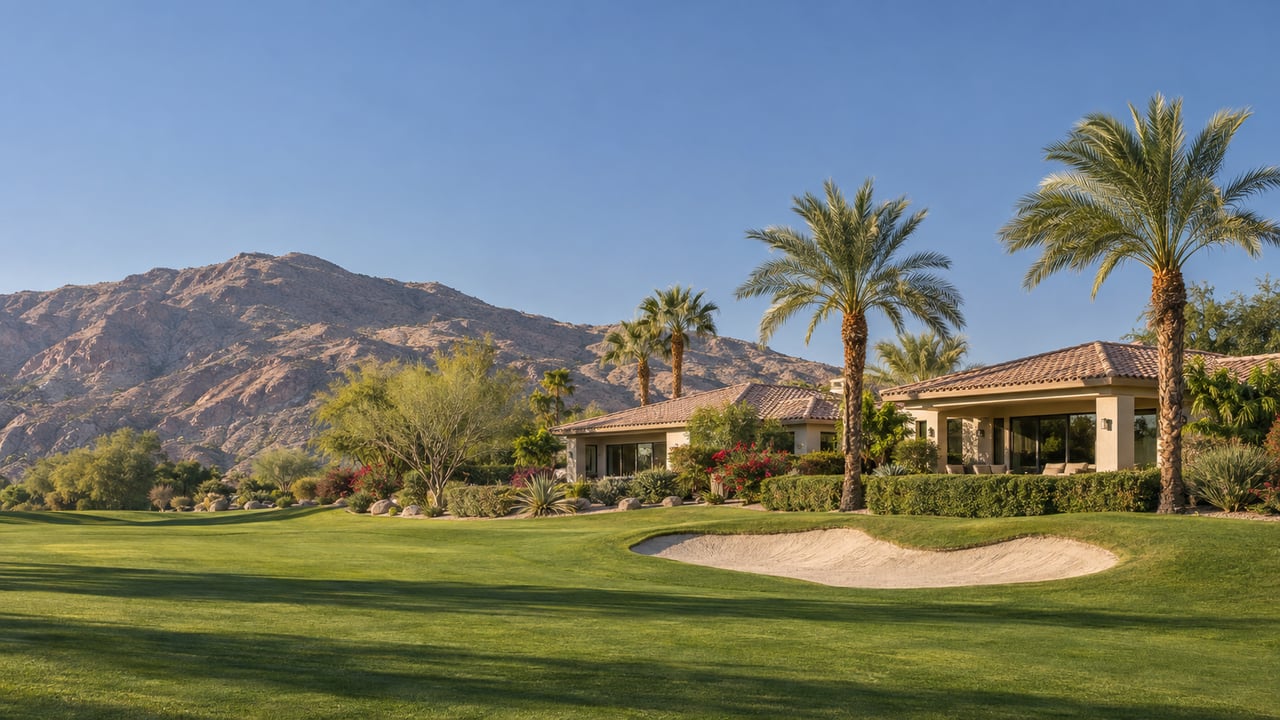
In August 2021, Lindi Biggi and her two children closed escrow on Shadow Mountain Golf Club. Gene Sarazen designed it, and it opened in 1958 as Palm Desert's first golf course. The reported price was $1.7 million, according to Club + Resort Business. Biggi told The Desert Sun that the family had made a 10-year promise not to sell the course for development. If you count from that August, the promise runs to about 2031.
For anyone touring Palm Desert golf course homes this season, Shadow Mountain is a useful case to start with. The surrounding streets have fairway views, and they also depend on the plans of the family that owns the course. Across the city, the course behind a house can belong to the homeowners as a group, to a private company, to a family or to the City of Palm Desert. Each kind of owner comes with its own dues, or none, and its own answer to who pays when grass, water and staff cost more than the course brings in. The monthly dues on a golf course home tell you who keeps the fairway green. When the dues are low, someone other than the homeowners is carrying that cost.
Shadow Mountain, where no HOA dues reach the course
Lorie Loftis, Biggi's daughter and co-owner, explained the course's finances in a June 2026 profile in the Coachella Valley Independent. She told the paper the club had fallen into disrepair before the purchase and that there were rumors it would be sold for housing. "None of the houses around the golf course pay an HOA fee, which is a huge part of the business plan for a golf course to be able to carry itself," she said.
She said live music, poker and trivia nights, and events at the pavilion bring in a second stream of income, and that only about 37 percent of the community actually golfs. Today Shadow Mountain Golf Club is open to public play, and memberships are optional.
A buyer near Shadow Mountain gets fairway views without any assessment for the course. What keeps that course open is the bar, the music calendar, green fees and an owner who chose to step in.
Palm Desert Country Club, where nine holes became Corterra
Palm Desert Country Club shows what can happen when a separately owned course has to make the numbers work. The rules of the Palm Desert Country Club Association, amended February 17, 2026, are direct about it. The golf course is "private property of which no portion belongs to the Association," and the Association has "no obligation or right to regulate or control" it.
In May 2015, The Desert Sun reported that homeowners there paid no assessment toward maintaining the course. It also reported that the nine-hole executive course had closed and that its owners had proposed timeshares on the 30 acres it occupied. The timeshares were never built. In 2018, the City of Palm Desert approved a 69-condominium plan for the same 30 acres, according to the city's projects in development page. That land is now being marketed as Corterra Golf Villas by Watermarke Homes, with model home previews offered by appointment.
The 18-hole course is still in play and is advertised as a public course. For a buyer, the executive course is the relevant history. Over about a decade, a separately owned course went from nine holes to a proposal for timeshares to a condominium project on the market, and the fairway view behind a nearby house changed with it.
Chaparral, where a social membership comes with every home
At Chaparral Country Club, the homeowners have a stake in the club. Every homeowner is automatically a social member of the country club. Social members can play golf by paying a daily fee when tee times are available, and full golf memberships are offered separately for those who want them, according to Chaparral's membership page.
Making the membership automatic gives the club a revenue base that does not depend on how many owners play. Chaparral is still a different structure from Shadow Mountain or Palm Desert Country Club, where homes and course stand apart. A buyer should ask for the current homeowner and club fee schedules before writing an offer, because Chaparral's posted pages don't list prices.
The Lakes, where the dues are the course budget
At the far end from Shadow Mountain is The Lakes Country Club. It was built in 1983 on 380 acres and has 902 condominiums and a 27-hole Ted Robinson course. According to the club's homeowner FAQ, all of the property and facilities are jointly owned and managed by the homeowners through The Lakes Country Club Association, Inc., under a nine-member board the owners elect.
That ownership is reflected in the dues. The FAQ currently lists annual homeowners' dues of $10,380, billed at $865 a month. Every owner must also become a Resident Social Member, with annual dues currently listed at $2,400 and a $1,000 annual food and beverage minimum that runs July 1 to June 30. Golf is a separate choice. A new owner decides within 30 days of closing whether to add golf, golf dues are currently listed at $5,520 a year, and each condominium can have up to two golf members. The FAQ does not show a date, so these figures reflect the club's current posting and should be confirmed with the club before an offer.
These figures are general information drawn from published club and association pages, not legal, tax or financial advice. Confirm the current numbers and how they apply to you with the association and the appropriate professional.
Compare that bill with Shadow Mountain. A Lakes owner who doesn't golf still pays more than $12,000 a year in homeowners' and social dues, at the rates currently listed, before spending anything on food. What that money pays for, along with landscaping, roads, pools and security, is a course owned by the 902 homeowners themselves and run by a board they elect.
Desert Willow, where the city owns the course and the land around it
Desert Willow Golf Resort is owned by the City of Palm Desert and operated by KemperSports, according to the city's Desert Willow page. With a public owner, the course's future is decided in city budgets and council meetings that anyone can follow. In November 2025, The Desert Sun reported that a renovation of the Firecliff course added new greens and reduced turf and trees.
The city also owns land around the course, and it is being developed. Palm Desert's 2024 annual report recorded DSRT Surf buying Lot B and breaking ground in May 2024. That project is now the surf park we wrote about in DSRT Surf Opened Before It Was Finished. The same report described a planned sale of Lot E to Blieu Development for 130 affordable homes. It also described an exclusive negotiating agreement with Kam Sang, owner of JW Marriott Desert Springs, for resort development on Lots C and D, with plans for a W-branded hotel expected at that time.
A home with Desert Willow views has a course owner that is unlikely to sell holes to pay its bills. That owner is also, by design, adding new neighbors to the area around the course. What you can see from a nearby patio depends on which lot is across the fairway.
What to ask before the offer
The five courses above have one thing in common. The cheaper a fairway view is to keep up, the less control the homeowner has over the course. That puts three questions near the top of any Palm Desert golf course search:
- Who owns the course behind the house?
- How does the course pay its bills: homeowners' dues, memberships and green fees, events, or a public budget?
- What has the course owner already done with its land?
Corterra and the Desert Willow lots answer the last question better than any brochure, because they show what each owner chose when it had land to put to use.
If you are weighing the same question in a neighboring city, our earlier post Why Two La Quinta Country Club Homes at the Same Price Rarely Cost the Same to Own is a good companion, and our Palm Desert page is the place to start in this city.
If you're comparing a fairway home at The Lakes with one along Shadow Mountain, or a resale near Desert Willow, I'd be glad to help you find out who owns the course behind each one and what it costs to keep green before you write an offer. Reach out to Kelly Ramsay, and let's connect.